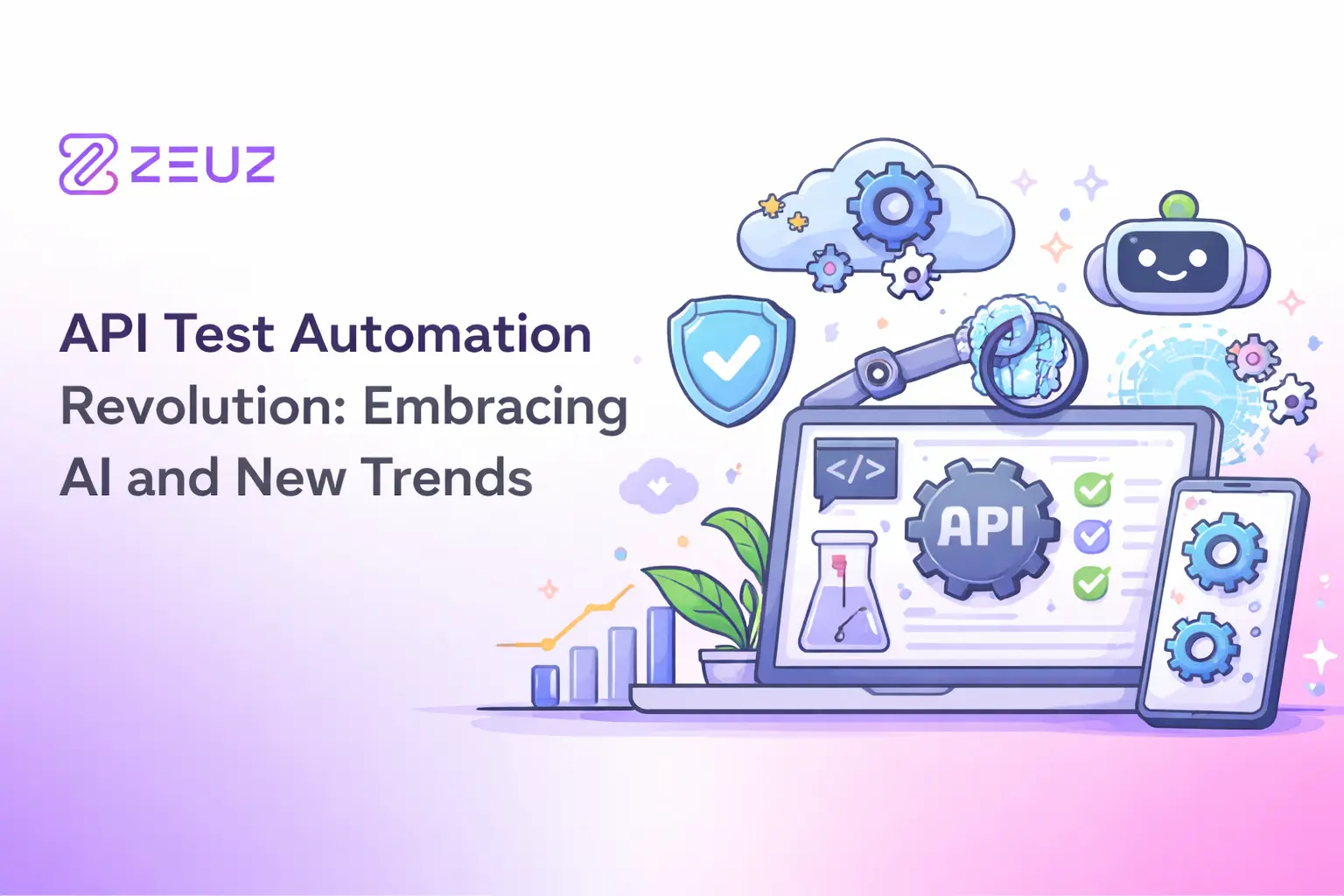
API Test Automation Revolution: Embracing AI and New Trends
Share with your community!
Behind every app that “just works,” there’s an army of automated tests ensuring the APIs behave as expected. Manual testing can’t keep up anymore. API test automation is how teams stay ahead of constant code changes. Add AI to that mix, and suddenly, your testing becomes predictive, adaptive, and continuous. It’s not the future anymore; it’s happening now.
What is API Test Automation
Every digital system talks to another using APIs. They exchange data, trigger workflows, and make apps feel seamless. But when one small call fails, it can crash the whole experience. API test automation prevents that chaos by running continuous checks on how requests and responses behave.
Unlike web automation or mobile automation, it focuses beneath the surface. It checks response times, logic, security, and how systems behave under load. A good automation setup connects everything—API testing, performance testing, and desktop automation—through a single workflow.
Platforms like ZeuZ make this possible with built-in test reporting, project management, and smooth Integrations for CI/CD pipelines. It’s how teams keep software stable while development never stops.
API Testing Evolution: From Manual to AI
The story starts simple—manual testing. Testers checked every endpoint, line by line. It worked when releases came once a month. But once daily deployments became the norm, it broke down.
Then came automation. Frameworks appeared. Teams built reusable scripts, added Flow Control, and tied them to test case management systems. It was faster, but not effortless. A single API update could still break dozens of tests.
Now, AI is rewriting the script. With Artificial Intelligence, test systems can learn patterns, auto-generate test cases, and detect where failures are likely to appear. Reports estimate this market will reach around USD 8.67 billion by 2033, showing how fast this shift is spreading.
Manual testing gave us precision. Automation gave us speed. AI brings intelligence—the ability to predict, not react.
Emerging Trends in API Testing Automation
The pace of testing is starting to look like development itself—continuous, adaptive, and data-driven. Here’s where API test automation is heading next:
1. AI-Generated Test Cases: No more manual setup. Natural language inputs can now create complete test flows instantly.
2. Built for CI/CD Pipelines: Tests run automatically with every code commit, turning QA into a continuous process, not an afterthought.
3. Unified Testing Ecosystems: Teams no longer juggle tools. API testing, performance testing, and desktop automation now live under one roof.
4. Security-Driven Testing: Token validation, access control, encryption—these checks are now baked into every test plan by default.
5. Smarter Reporting and Analytics: Advanced test reporting doesn’t stop at pass/fail. It tracks patterns, reveals industry challenges, and even compares past builds.
6. Deep Integrations: Modern platforms link directly to documentation, dashboards, and bug trackers, closing the loop between testing and release.
Enhancing API Testing with Artificial Intelligence
AI came to make testing smarter. Traditional automation was great at repetition, but not at reasoning. When AI meets API test automation, it transforms every test cycle into a learning cycle. Here’s what that really means in practice:
1. Smarter Test Generation
You write a simple description, and AI turns it into a complete test flow. It maps endpoints, creates data sets, and defines validations automatically. That means faster setup, fewer mistakes, and instant coverage expansion.
2. Predictive Maintenance
AI watches for subtle changes in API behavior and adapts before things break. Instead of reacting to failures, it keeps the system running smoothly by predicting weak points in advance.
3. Continuous Learning
Every test run makes the system sharper. Over time, AI learns which endpoints are unstable, which parameters cause failures, and how to prevent them next time. Testing becomes an ongoing feedback loop.
4. Real-Time Debugging Help
When something fails, AI pinpoints the issue within seconds. No scrolling through endless logs, it shows what broke, why, and what to fix, helping QA teams stay in the flow.
5. Self-Healing Scripts
APIs change constantly. AI tracks those changes, updates identifiers, and repairs test paths without manual input. It’s maintenance that happens quietly in the background.
6. Insightful Reporting
AI doesn’t stop at “pass” or “fail.” It explains outcomes, detects trends, and adds context through detailed test reporting. Every report becomes a source of clarity instead of confusion.
7. Smarter Integrations
AI links results to project management, test case management, and development systems automatically. That means QA insights reach the right people at the right time, without another spreadsheet in sight.
Manual API Testing vs. AI-Driven API Testing
Manual testing will always have its place, it’s how intuition catches what code can’t. But when the goal is speed, consistency, and scale, AI wins the long game.
Here’s the difference in one glance:
|
Aspect
|
Manual API Testing
|
AI-Driven API Testing
|
|
Setup Time
|
Long and repetitive
|
Automatic from natural language
|
|
Maintenance
|
Breaks with every change
|
Self-healing and adaptive
|
|
Speed
|
Slow execution
|
Parallel, continuous execution
|
|
Learning
|
Human-dependent
|
Learns from every test run
|
|
Error Detection
|
Reactive
|
Predictive
|
|
Scalability
|
Limited by team size
|
Scales with compute power
|
|
Reporting
|
Static logs
|
Intelligent, pattern-based analytics
|
Final Words
API test automation isn’t some magic wand that fixes everything. You still need clear requirements, good test design, and people paying attention. But when you use AI the right way, it can really help, saving QA engineers from boring, repetitive stuff so they can focus on the tricky edge cases, security issues, and user experience. If you want to build smarter systems, give ZeuZ a shot. Start with the overview and check out all the features to see if it’s a good fit for your team.