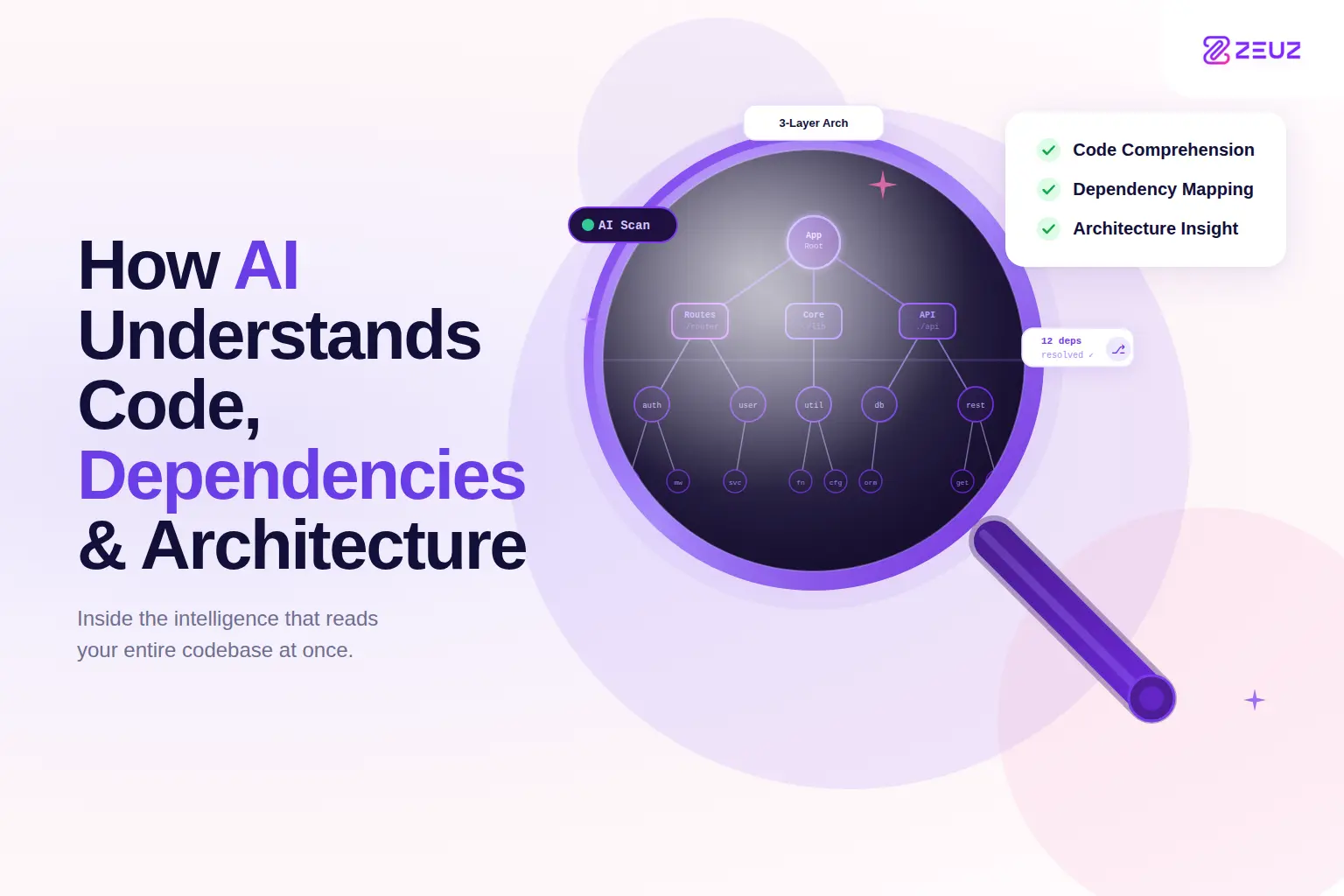
How AI Understands Code, Dependencies, and Architecture
Share with your community!
Let’s be honest.
Most developers don’t fully understand their entire system.
They understand their part. Their service. Their module. Maybe a few connected components. But the full picture?
That gets blurry, fast.
Modern software is too complex:
-
Microservices
-
APIs
-
Third-party integrations
-
Distributed systems
And as systems grow, one thing becomes harder than writing code:
→ Understanding how everything connects
This is exactly where AI is stepping in, not just to write code, but to understand the system itself.
Let’s break down how AI actually does that.
Why System Understanding is the Real Problem
Before we talk about AI, we need to clarify the real challenge.
It’s not just coding.
It’s:
-
Knowing what depends on what
-
Understanding how a change impacts other components
-
Identifying where risk is hiding
Without this, teams face:
-
Unexpected bugs
-
Broken integrations
-
Risky deployments
Even with AI in software engineering, if the system is not understood, problems don’t go away.
From Code to Context: The Shift AI Enables
Traditional tools treat code as isolated files.
AI treats code as part of a connected system.
This is a major shift.
Instead of asking:
→ “What does this function do?”
AI asks:
→ “How does this function affect the entire system?”
How AI Understands Code
Let’s start with the basics.
AI analyzes code using:
1. Pattern Recognition
AI models trained on large codebases can:
This is what powers tools like:
But that’s just the surface.
2. Semantic Understanding
AI does not just read syntax. It understands meaning.
It can identify:
This is where AI-driven software development becomes more than just automation.
3. Change Impact Analysis
When a developer makes a change, AI can:
This reduces unexpected side effects.
How AI Maps Dependencies
Dependencies are where most complexity hides.
A small change in one service can impact:
-
APIs
-
Databases
-
External integrations
AI handles this through:
1. Dependency Graphs
Using engineering intelligence tools, AI builds:
→ A visual and machine-readable map of how everything connects
This includes:
2. Real-Time Updates
Unlike static documentation, AI continuously updates:
-
New dependencies
-
Changed relationships
-
Emerging risks
This creates a living system map.
3. Hidden Dependency Detection
Some dependencies are not obvious.
AI can detect:
This is something manual tracking almost always misses.
How AI Understands Architecture
Architecture is more than just diagrams.
It’s about how systems behave in real conditions.
AI analyzes architecture by combining:
1. Code + Runtime Data
AI looks at:
-
Code structure
-
Execution behavior
-
Performance metrics
This creates a complete picture.
2. System Patterns
AI identifies architectural patterns like:
-
Microservices
-
Event-driven systems
-
Layered architectures
And evaluates how well they are implemented.
3. Risk Mapping
AI can highlight:
-
Bottlenecks
-
Fragile components
-
High-risk integrations
This is critical for AI-driven software development.
From Understanding to Intelligence
Here’s the key shift:
This is what creates system intelligence.
Instead of asking:
→ “What is happening?”
You get answers to:
→ “Why is it happening?”
→ “What will happen next?”
The Role of AI Software Development Platforms
To make this possible, you need more than standalone tools.
An AI software development platform connects:
-
Code
-
Testing
-
DevOps
-
Product data
This creates a unified system where AI can:
Impact on the Software Development Lifecycle (SDLC)
Understanding code and dependencies affects every stage of the SDLC.
1. Planning
2. Development
-
Safer code changes
-
Reduced bugs
3. Testing
4. Deployment
Connecting Engineering with Business Intelligence
AI doesn’t stop at technical understanding.
It connects with:
This allows teams to see:
-
Which components affect revenue
-
Where failures impact users
-
How technical decisions align with business goals
This is a key part of AI product development.
Why This Matters More Than Ever
Modern systems are too complex for manual understanding.
Without AI:
With AI:
-
Systems become understandable
-
Decisions become data-driven
-
Complexity becomes manageable
Challenges to Keep in Mind
This capability is powerful, but not trivial.
1. Data Integration
AI needs access to all system data.
2. Accuracy of Models
Poor data leads to weak insights.
3. Adoption
Teams must trust AI recommendations.
But as systems evolve, this becomes unavoidable.
The Future of Software Engineering
We are moving toward:
-
Systems that explain themselves
-
AI that understands architecture
-
Development guided by intelligence
This is the next phase of artificial intelligence software development.
Final Thoughts
AI is no longer just helping developers write code.
→ It is helping them understand the entire system.
From:
-
isolated code
to
-
connected intelligence
From:
-
manual analysis
to
-
automated understanding
And that changes everything.
One Clear Takeaway
AI transforms software engineering by turning code, dependencies, and architecture into an understandable, intelligent system.
FAQS
Q1. How does AI understand code beyond just reading syntax? AI uses semantic understanding to interpret what a function intends to do, how data flows through the code, and where logic might break, going far deeper than simple pattern recognition.
Q2. How does AI detect hidden dependencies in a software system? AI builds dependency graphs that map service-to-service relationships, API interactions, and data flow paths, including indirect and implicit connections that manual tracking almost always misses.
Q3. Can AI predict the impact of a code change before it's deployed? Yes. AI performs change impact analysis by scanning affected components, predicting potential failures, and highlighting risky areas, helping teams avoid unexpected side effects before deployment.
Q4. How is AI-driven software development different from traditional development tools? Traditional tools treat code as isolated files. AI treats code as part of a connected system, answering not just "what does this do?" but "how does this affect everything else?"
Q5. How does AI help with software architecture analysis? AI combines code structure, runtime behavior, and performance metrics to identify architectural patterns, detect bottlenecks, flag fragile components, and map high-risk integrations across the system.
Q6. What are the biggest challenges of adopting AI in software development? The three main challenges are data integration (AI needs access to all system data), model accuracy (poor data leads to weak insights), and team adoption (developers must learn to trust AI-generated recommendations).