ZeuZ vs Selenium: Enterprise Reporting and QA Analytics Compared
Share with your community!
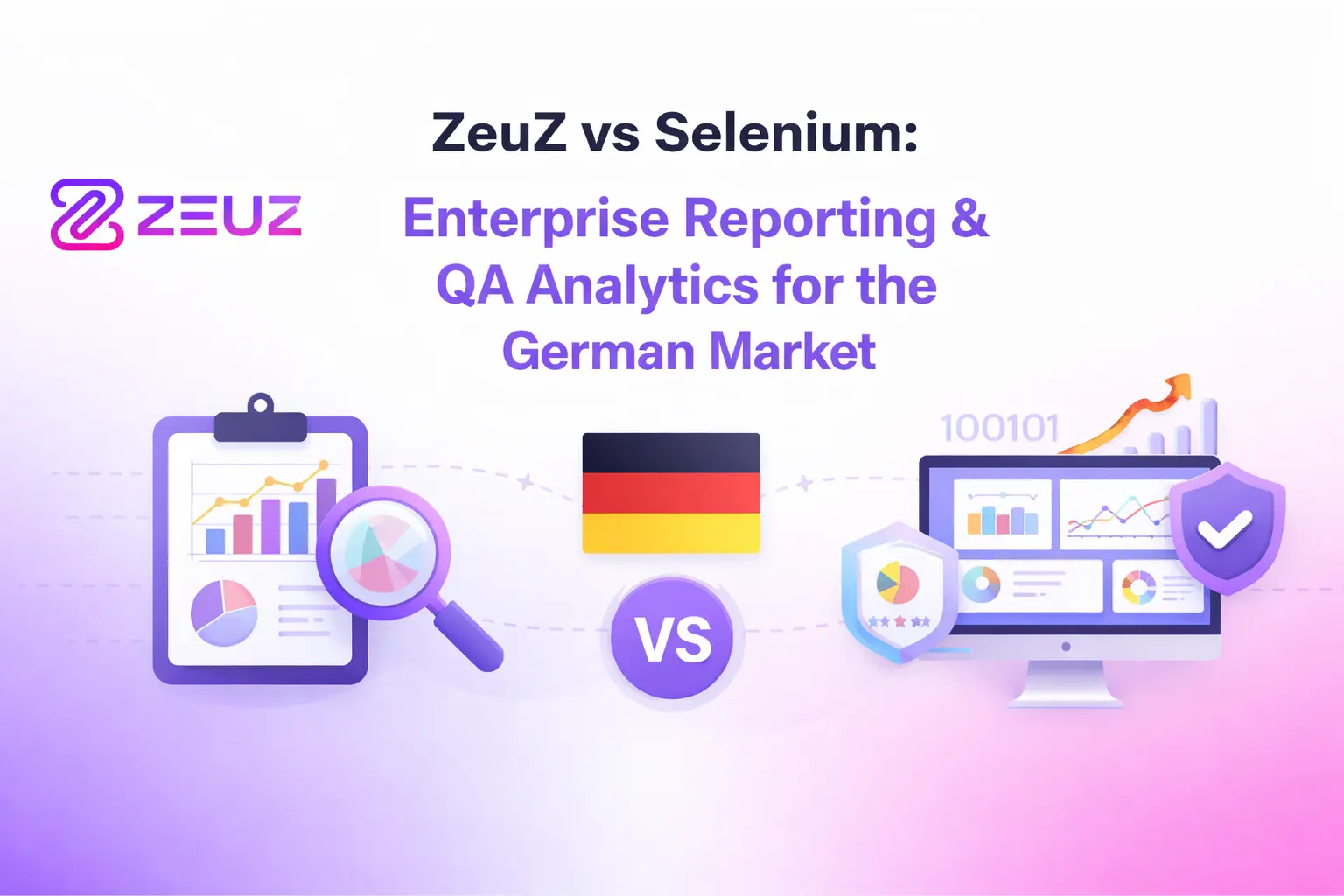
ZeuZ vs Selenium: QA Analytics for Germany
As German companies accelerate digital transformation in banking, automotive, healthcare, retail, and public services, software quality has become a strategic priority, not just a technical one. Enterprises are under pressure to release faster, integrate with CI/CD pipelines, maintain strong compliance, and demonstrate ROI from QA investments. In this context, test automation platforms are evaluated not only on scripting or execution, but heavily on reporting, analytics, and traceability.
Two tools often considered in German QA teams are ZeuZ, an all-in-one commercial test automation platform, and Selenium, the widely adopted open-source UI automation framework. Both can automate tests, but their reporting and analytics capabilities differ dramatically.
This article breaks down those differences specifically through the lens of German enterprise requirements.
What German Enterprises Expect From QA Reporting
Germany’s enterprise and Mittelstand environments care about:
-
Compliance traceability (GDPR, medical, finance, automotive)
-
Central reporting dashboards for leadership
-
Cross-team transparency (Dev, QA, DevOps)
-
KPIs such as MTTR, failure rates, coverage, ROI
-
Documentation quality for audits and certifications
-
Long-term test artifact retention
-
Integration with CI/CD and ticketing tools
These expectations influence tool selection far beyond pure automation speed.
Selenium Overview:
Script-Driven UI Automation With Minimal Native Reporting
Selenium is an open-source automation framework used for browser testing. It is highly flexible, coding-focused, and widely adopted by developers. However, when evaluating pure reporting and analytics, Selenium falls short for enterprise environments.
Strengths
-
Open source (no licensing costs)
-
Huge global community
-
Strong ecosystem of language bindings
-
Flexible integration into CI/CD
Reporting & Analytics Limitations
Selenium itself provides:
Selenium lacks centralized results dashboards and enterprise reporting features
Teams typically rely on third-party plugins like:
This leads to fragmented reporting stacks that need maintenance and internal expertise.
For German firms with strict compliance, documentation, and audit requirements (especially in finance, automotive, healthcare, and public infrastructure), relying on stitched-together reporting chains introduces complexity and operational risk.
ZeuZ Overview:
All-in-One Automation With Centralized Reporting & Governance
ZeuZ is a commercial, all-in-one test automation platform that covers UI, API, mobile, performance, and security testing within a single system. While Selenium is code-centric, ZeuZ offers no-code, low-code, and scripted options.
Where ZeuZ stands out for the German market is in enterprise-grade reporting and compliance.
Built-In Reporting & Analytics Features
The PDF highlights multiple reporting capabilities unavailable in Selenium, including:
-
Centralized results dashboards
-
Executive dashboards & KPI drilldowns (MTTR, MTBF, ROI)
-
Root-cause analysis & failure clustering
-
Predictive flakiness forecasting (ML-based)
-
Test coverage & gap analysis
-
Audit trails & compliance reporting
Supporting enterprise governance matters in Germany especially due to:
ZeuZ also supports:
-
Role-based access control (RBAC)
-
Traceability linking requirements, tests, and defects
-
Encrypted artifacts & retention policies
-
Compliance templates (PCI, HIPAA, GDPR)
These are directly relevant for regulated German environments.
Artifact & Evidence Handling: A Critical Factor in Germany
One overlooked requirement for German enterprises is artifact retention and evidence tracking for audits such as ISO, TISAX, BAIT, or internal IT governance.
ZeuZ offers:
Selenium offers none of this natively and requires stitching together tools like:
For evidence-driven industries like automotive validation, fintech, healthcare products, and public infrastructure, this is a major distinction.
Executive-Level Reporting & ROI Measurement
In the German market, QA leaders increasingly must justify:
-
Budget allocation
-
Tool spend
-
Headcount distribution
-
Testing strategy
ZeuZ includes executive dashboards tracking:
Selenium offers none of these metrics without heavy customization.
CI/CD & DevOps Reporting
Both tools integrate with CI/CD, but depth differs:
Selenium
-
Relies on Jenkins, GitHub Actions, GitLab CI, Azure DevOps plugins
-
Reporting depends entirely on external tools
ZeuZ
Provides:
-
Native connectors for CI/CD platforms
-
Auto-triggered reporting on PR/merge/build events
-
Dashboard views for pipeline health
-
Aggregated cross-pipeline analytics
This matters for German companies using GitOps, DevOps, and cloud modernization.
Cost Structure & Total Cost of Ownership (TCO)
This is where German companies have clear preferences:
Selenium
-
License cost: zero
-
Hidden cost: high (staffing, tools, maintenance)
-
Requires: reporting tools, dashboards, cloud execution, artifact management
ZeuZ
For enterprises in Germany prioritizing predictable cost models, TCO often matters more than initial license savings.
Which Tool Fits the German Market Better?
Choose Selenium if your team:
✔ Has strong coding capabilities
✔ Prefers full customization over convenience
✔ Doesn’t need compliance or governance reporting
✔ Has time to assemble a reporting stack
Choose ZeuZ if your team:
✔ Requires centralized reporting & analytics out of the box
✔ Operates in a regulated German market (finance, auto, medical, public sector)
✔ Needs executive dashboards and compliance artifacts
✔ Wants cross-testing (UI + API + Mobile + Performance) in one suite
✔ Works with CI/CD at scale
Conclusion
For teams in Germany focused on modern, enterprise-grade QA with traceability, compliance, analytics, and business reporting, ZeuZ clearly provides a more complete offering. Selenium remains a strong developer-friendly automation framework, but lacks native capabilities required for regulatory evidence, management reporting, and ROI transparency, gaps that German enterprises increasingly cannot ignore.
In the end, the right choice depends on whether QA is treated as code execution, or as a strategic enterprise function that demands governance, metrics, and documentation.